Welcome to TRADLINX API
1. Welcome to TRADLINX Ocean Visibility
The TRADLINX Ocean Visibility API offers global logistics providers, freight forwarders, and supply chain platforms a robust solution for integrating reliable shipment tracking into their systems.
Integrate TRADLINX tracking and MapView with your existing systems—like FMS, SAP, TMS, or ERP—and start managing shipments with confidence.
- 🗺 Visualize Shipment/Vessel Movements with embeddable MapView components
- 📦 Access essential shipment data—including ETD, ETA, ATD, and ATA—to gain visibility into key logistics milestones from Container Pick up to Gate-Out/Empty Return.
- 🔗 Automate data synchronization across FMS, TMS, ERP, SAP and internal systems
2. What is TRADLINX Ocean Visibility API?
a. API Integration Types
Tracking API
- A standardized REST API that lets clients retrieve enriched Shipment/Vessel tracking data using identifiers such as Master B/L, Container number, Booking number and Vessel ID
- Tracking data displayed in grid view on Ocean Visibility is available via API, enabling you to build custom dashboards for import/export shipment management.
- Tracking Numbers Supported by API
- Supported IDs: Master B/L, Container No., Booking No., Vessel ID
- Unsupported IDs: House B/L, Seal Numbers, Internally generated numbers (ex. PO numbers or customer reference numbers.)
Embedded MapView
-
A secure, iframe-based tracking interface that visualizes real-time Shipment/Vessel locations, routes, and related events.
-
Can be seamlessly embedded into your customer portal or internal shipment system.
-
Grouping of shipments and vessels by registered client name or group, with MapView list filters enabling selective viewing of target customer entries—even when managing large volumes.
Type Description via Master B/L Monitoring real-time location, route, and container events based on M. B/L via Vessel ID Monitoring real-time location and status of vessels based on vessel IDs
b. Basic API Workflow
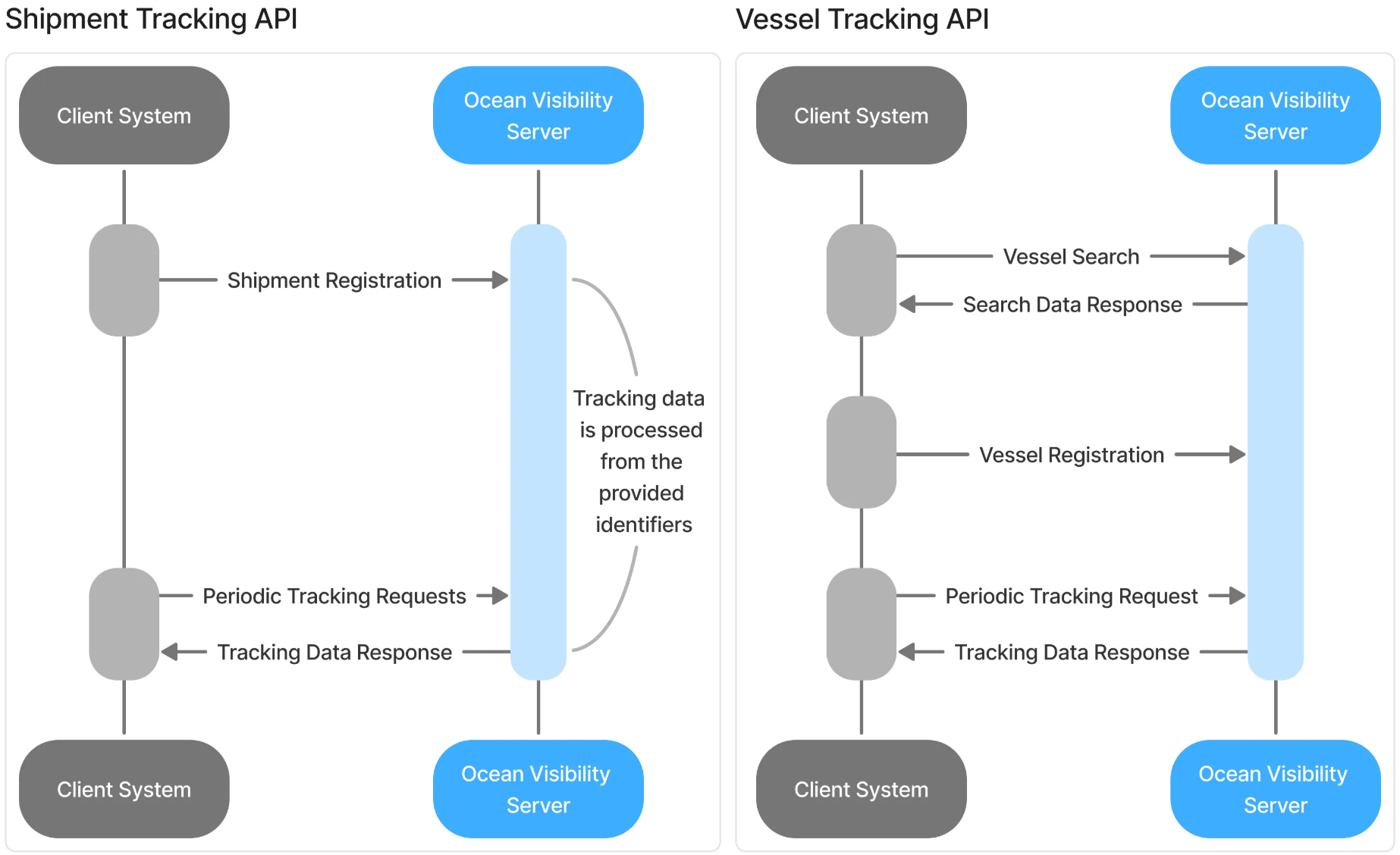
- TRADLINX Ocean Visibility operates on a basic flow of registering tracking ID and retrieving tracking data.
- Registration: The client system sends tracking identifiers to the TRADLINX system to register a shipment or vessel.
- Tracking Data: The client system periodically sends those identifiers to request tracking updates from TRADLINX.
c. Tracking API Response Data
| Response Data | Description |
|---|---|
| POL | Port of Loading |
| POD | Port of Discharge |
| Origin | Place of origin (Data is available only for certain carriers) |
| Destination | Final destination (Data is available only for certain carriers) |
| TS Port | Port(s) for Transshipment |
| ETD / ETA | ETD / ETA reported by the carrier |
| ATD / ATA | Actual Time of Departure/Arrival reported by the carrier |
| Port Call ATD / ATA | Actual Time of Departure/Arrival based on AIS data |
| TS ETD / ETA | ETD / ETA of TS reported by the carrier |
| TS ATD / ATA | ATD / ATA of TS reported by the carrier |
| Container Number (size, type) | All container numbers in the Master B/L |
| Vessel Information | Vessel Name, IMO, MMSI, Call Sign, Vessel Schedule, Vessel Route |
| Door-to-Door Container Events | Estimated / Actual container events both port and inland (varies by carrier/region) - Supported events: Container Pickup, Gate-In/Out, Empty Return, Inland Transport Events (Rail, Truck) and more. |
| Tracking MapView | Visibility of Shipment/Vessel movement on map view |
| Dashboard MapView | Comprehensive monitoring map view of all shipments |
d. API Updates & Compatibility Guidelines
🔔 API Update & Backward Compatibility Notice
The TRADLINX Ocean Visibility API may be updated from time to time to improve service quality, expand data coverage, and introduce new features.
When updating the API, we prioritize the stable operation of existing integrations and follow backward-compatible change principles, such as adding new fields.
Accordingly, we recommend that client systems be implemented in a backward-compatible manner so that they can continue to operate normally even when unknown or newly added fields are included in API responses.
If any changes may affect existing integrations, we will provide advance notice.